Why Los Angeles Foundations Are Uniquely Vulnerable
Los Angeles sits atop one of the most geologically active regions in North America. The combination of expansive clay soils that swell during winter rains and shrink during dry summers, hillside terrain prone to settlement, and a seismic environment that delivers regular ground motion creates a perfect storm of stresses on residential foundations. Homes built before 1980 — which represent a significant share of the housing stock in East Los Angeles, Boyle Heights, Glendale, and the San Gabriel Valley — often sit on unbraced cripple walls that are particularly vulnerable to earthquake damage.
Understanding the early warning signs of foundation distress can save Los Angeles homeowners tens of thousands of dollars by catching problems before they escalate. Our team at ADU Builders & Foundation Repairs performs thorough foundation assessments and provides clear, honest recommendations based on what we find.
Warning Sign #1: Diagonal Cracks at Door and Window Corners
One of the most telling indicators of differential foundation settlement is a stair-step or diagonal crack radiating outward from the corner of a window or door frame. Unlike hairline shrinkage cracks in plaster that run vertically or horizontally, diagonal cracks signal that one portion of your foundation is moving at a different rate than another. If these cracks are wider than 1/4 inch, are growing over time, or are accompanied by a door or window that no longer closes flush, the problem warrants prompt professional evaluation.
Warning Sign #2: Sticking Doors and Windows
When a door that once swung freely begins to drag across the floor or a window requires force to open, many homeowners assume the cause is seasonal wood swelling. While humidity changes can cause minor sticking, persistent sticking throughout the dry season is more likely caused by the door or window frame racking slightly out of square due to foundation movement beneath the wall. This is especially common in older Los Angeles bungalows and Craftsman homes where wood framing has been repeatedly stressed by minor seismic events.
Warning Sign #3: Sloping or Bouncy Floors
Place a marble on your hardwood or tile floor. If it rolls consistently toward one corner of the room, your floor is no longer level — and in most cases, the culprit is uneven foundation settlement rather than subfloor warping. Soft or springy spots underfoot in crawl-space homes can indicate rotting wood girders, failing posts, or beam connections that have shifted. Both conditions are repairable, but the longer they go unaddressed, the more extensive the remediation becomes.
Warning Sign #4: Gaps Between Walls and Ceilings or Floors
Visible separation between an interior wall and the ceiling above it, or between a wall base and the floor, indicates that the home is racking — twisting slightly out of its intended square configuration. This can result from soil movement under one corner of the foundation, root intrusion from nearby trees, or inadequate original construction. Gaps that appear suddenly after a rain event or earthquake are especially worthy of immediate investigation.
Warning Sign #5: Cracks in the Concrete Stem Wall or Slab
Horizontal cracks in a concrete stem wall are serious and often indicate lateral soil pressure exceeding the wall's design capacity — a common condition in hillside Los Angeles properties after heavy rainfall. Vertical cracks in a slab may result from shrinkage but can also signal voids forming beneath the concrete as soil erodes or settles. Wide cracks with vertical displacement (one side higher than the other) point to differential settlement that requires structural intervention.
Warning Sign #6: Exterior Stucco Cracking Near the Foundation
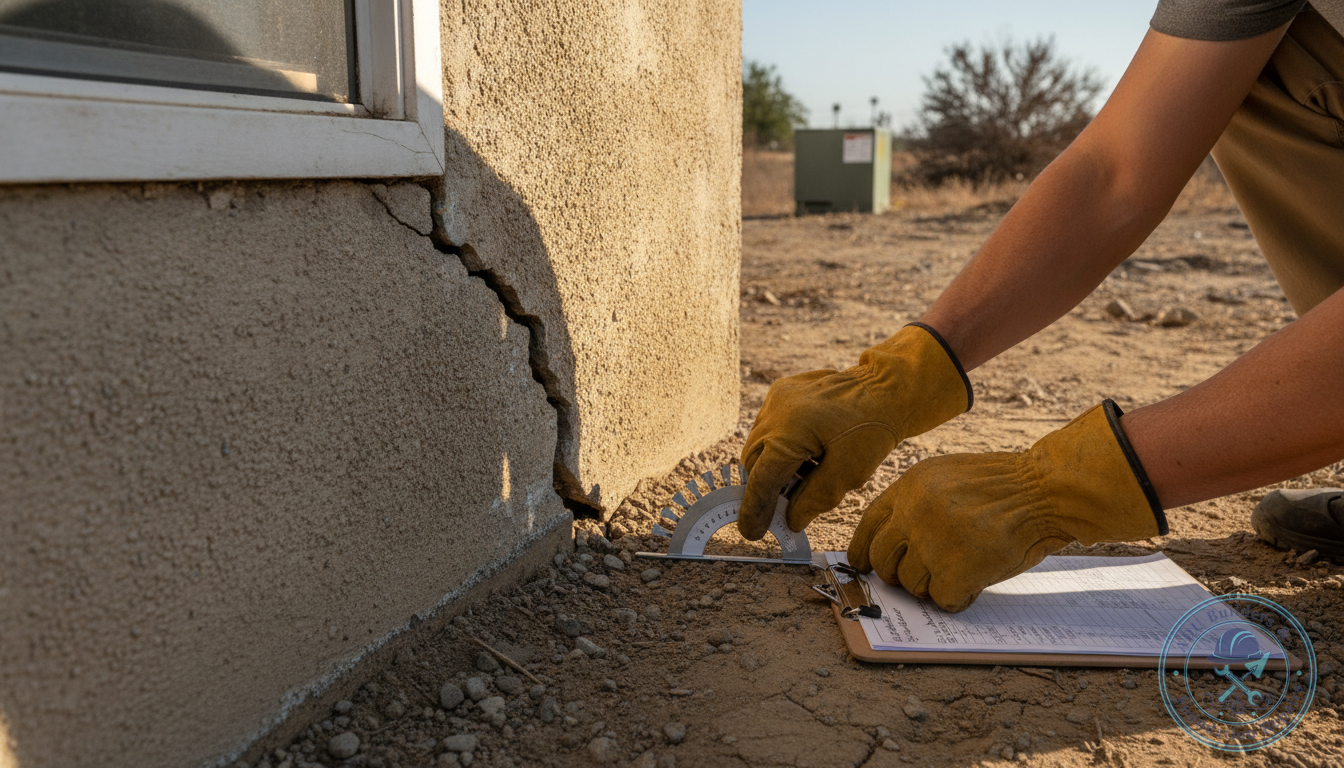
Long diagonal or stair-step cracks in exterior stucco, particularly near the base of the wall closest to grade, often mirror what is happening structurally at the foundation level. While stucco cracks can result from normal curing or minor shrinkage, patterns that follow mortar joints or appear after wet seasons deserve a closer look at the foundation behind them.
What to Do When You Spot These Signs
If you notice one or more of these warning signs in your Los Angeles home, the first step is to document them with photos that capture the crack width, orientation, and location. Note whether the crack appears to be growing by marking the ends with pencil and checking back over several weeks. Then, schedule a professional foundation inspection.
Our foundation team serves homeowners throughout Los Angeles and nearby communities including Monterey Park, Alhambra, South Gate, and Montebello. We assess root causes — whether expansive soils, drainage failures, or inadequate original construction — before recommending the most cost-effective long-term solution.
Common Foundation Repair Methods We Use
- Helical and push piers — Steel piers driven deep into stable soil to lift and stabilize a settling foundation.
- Crack injection — Epoxy or polyurethane injection to seal cracks and restore tensile strength in concrete stem walls and slabs.
- Mudjacking and slab leveling — Pumping a cement-soil slurry beneath a sunken slab to restore level grade.
- Cripple-wall bracing — Installing plywood sheathing and anchor bolts in the crawl space to resist seismic lateral forces in pre-1980 wood-frame homes.
- Drainage correction — Regrading, installing French drains, or correcting downspout discharge to eliminate the water source driving soil movement.
The Case for Seismic Retrofitting
Even if your home shows no current distress signs, voluntary seismic retrofitting is one of the highest-return structural investments available to Los Angeles homeowners. The LA Department of Building and Safety has documented that properly retrofitted cripple-wall homes suffer dramatically less damage in moderate-to-strong earthquakes compared to unretrofitted structures. Some insurance carriers also offer premium discounts for retrofitted homes.
Our foundation repair and retrofitting services include cripple-wall plywood installation, anchor bolt upgrades, and hold-down hardware installation — all documented with before-and-after photos and covered by a written warranty.
Pairing Foundation Work with Your Next Project
If you are planning an ADU, room addition, or kitchen renovation, addressing foundation concerns first is essential. A new structure built on a compromised foundation risks developing the same settlement and cracking issues immediately. Our general contracting and project management team coordinates foundation repair and new construction under one plan, ensuring both phases are perfectly sequenced and that no time or money is wasted by having separate contractors working at cross-purposes.
Contact ADU Builders & Foundation Repairs at (213) 583-5800 to schedule a foundation assessment. We are available seven days a week, 8:00 AM to 6:00 PM, and serve homeowners across greater Los Angeles.
Questions about general contractor in Los Angeles, CA? We're happy to help — no sales pressure.
Talk to a Local Pro
Call +12135835800 or fill out our online form for a free, no-obligation quote.
Request Free Quote